


PDF
Download
Citations
Click and drag then release to select a passage to cite.
Annotations
How to submit annotations to Mizan Journal articles:
your work is published.
Search within
A Rhetoric for Unrequited Love in Nezāmi’s Khosrow and Shirin
Image
Audio
Video
Chart or Graph
A Rhetoric for Unrequited Love in Nezāmi’s Khosrow and Shirin
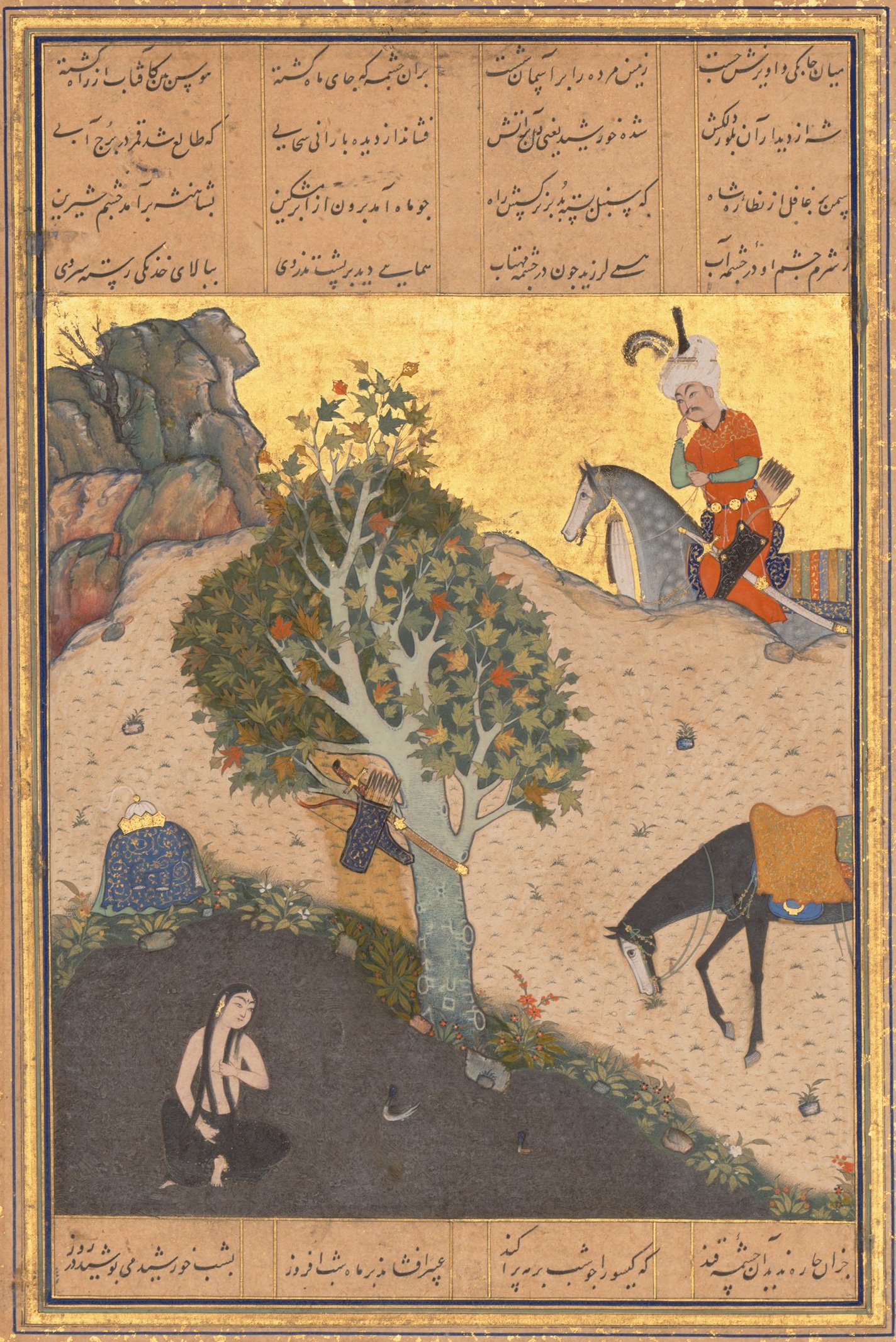
“Khusrau Catches Sight of Shirin Bathing,”
Folio 50 from a Khamsa (Quintet) of Nizami of Ganja (d. 1209)
Painting by Shaikh Zada (active 1510–1550)
https://www.metmuseum.org/art/collection/search/446594.
Nezāmi’s Khosrow and Shirin dramatizes an interaction of two different kinds of poetics and two different kinds of rhetoric, each conveying their own codes and conventions. In a previous study, I had focused on the poetics, as it were, of two so-called “musicians,” Bārbad and Nakisā, who are represented as performing their songs in such a way as to typify the characters of Khosrow and Shirin respectively. In the present study, the focus of interest shifts from two kinds of poetics to two kinds of rhetoric, which are exemplified by a set of questions and answers attributed to two rival lovers of Shirin, namely, Khosrow the king and Farhād the artisan.
These rival lovers, Khosrow and Farhād, are represented as engaging in a verbal duel that contrasts the values of the poetic genre of classical Persian romance with the values of a worldview that is conventionally known as Sufism. This rivalry is dramatized in a poetic form where each of the two speakers is restricted to one poetic line for each of their utterances, which follow one after the other in a rapid-fire rhetorical exchange of point and counterpoint, matched by a poetic exchange of metrically as well as syntactically parallel wording.
Such a set of one-line rhetorical exchanges between two speakers is comparable to a poetic device known as “stichomythia” in the poetics of classical Greek drama. The interaction of the lines spoken by Khosrow and Farhād in this Persian equivalent of “stichomythia” reveals two different models of a theme conventionally known as unrequited love.
In this case, the rival lovers of a woman who figures as their love-object experience the non-requital in different ways. Whereas Khosrow the king fears non-requital of his love for Shirin because he fears that the love of Farhād the artisan for this same woman will indeed be requited, the artisan willingly accepts non-requital of his own love for Shirin because he somehow knows that this love of his must be transcendent: he must love being in love.
To be in love with love means that, for Farhād, his love for Shirin must be unrequited, and such unrequited love transcends all other kinds of love. Such a transcendent rhetoric of unrequited love, I argue, matches the transcendence of love poetry as loved by Nezāmi himself in his role as poet.
My essay about this kind of love poetry has been strongly influenced by an article written by the late Firoozeh Khazrai, “Music in Khusraw va Shirin,” which focuses on two episodes in Khosrow and Shirin. In the first episode, we read about the poetics, as it were, of two so-called “musicians,” Bārbad and Nakisā, who are represented as performing their songs in such a way as to typify the characters of Khosrow and Shirin respectively. The second episode, about the unrequited love of two rival lovers of Shirin, namely, Khosrow the king and Farhād the artisan, informs the present study.
As Khazrai has argued, the characters of Khosrow and Farhād show radical differences in the way they love a woman, and they have no “common ground,” as she says, of communication with each other—except, that is, through lyric exchange. This exchange seems to betray different genres of lyric projection. Whereas the persona of Khosrow is kingly, the persona of Farhād is something quite different. There is no obvious term for what this different poetic persona might be, but one thing is for sure: it certainly is not kingly. This poetic persona is closer to the poetic persona of Nezāmi himself. Moreover, toward the end of the poem, the character of Khosrow himself takes over the characteristics of the persona of Farhād, and the words of Farhād practically predict such an eventual persona during his exchange of lyrical verses with Khosrow.
There is bleak irony at the end when the patterns merge into one with the death of both the king and his beloved queen. But by then, and mainly through the vehicle of dialogues, the king leaves the pages of a heroic epic and enters what can loosely be labeled a romance.
A closer look at the exchange of lyrical verses between Farhād and Khosrow reveals the two distinct worlds of heroic epic and romance in competition for the same space. The ideals of Khosrow are those of a young warrior. Splendid horses and beautiful women are on a par; both are highly desirable possessions to pursue and enjoy. But this heroic landscape is abruptly pitted against the strange realm of the self-annihilating lover of the romance. The two lovers of the beautiful Shirin, the heroic king Khosrow and the romantic artisan Farhād, confront each other in a debate, a monāzera, a genre with many parallels in other medieval literatures. Here Nezāmi’s dramatic powers are on full display, and conventions are overhauled to enhance the impact of the pivotal encounter. Farhād is pictured not as an emaciated weakling of a lover. He is a giant of a man, exuding an aura of defiance rather than dejection.
The lyric exchange between the two rival lovers of Shirin takes form as a series of questions and answers, with Khosrow attempting to take measure of the feelings of Farhād towards Shirin. The questions seem innocent enough at first, but soon turn into an exercise in mutual non-comprehension with a double-edged outcome that propels the narrative forward not only to the tragic death of Farhād but also, ironically and indirectly in the finale, to the tragic death of a Khosrow himself, for whom his love for his beloved by now transcends the idea of possessing the beloved. Khosrow, called “the just” with a heavy dose of irony when he plots his rival’s death, transcends his former possessive self through the power of love. He and his queen share the heroically tragic end that awaits all doomed lovers. The monāzera, the clash of two codes, is ultimately instrumental in uniting the two ultimately unrequited rival lovers and their clashing codes in their death.
I close with a literal translation of this lyric exchange:
The exchange starts with a description of Farhād.
They brought him in – he was like a mountain
A huge crowd followed himHe looked neither at Khosrow nor at the throne –
Like a lion he clawed hard into the ground.The doleful love of Shirin had driven his heart in such a way
That he cared not for Khosrow and himself.The king decreed lavish hospitality for him
At every step they threw coins and presents on his path.They seated that giant of a man,
Scattering gold coins all around his impressive stature.But since there was but one gem in his pristine heart
concerning precious goods, gold and dust were all the same to him.Since his guest did not deign to appreciate the gold,
Khosrow himself opened his lips to pour out a treasury of gems [in speaking].To each pointed salvo that Khosrow had prepared,
He returned a pithy response.To begin, Khosrow asked him, “Where are you from?”
He responded, “From the realm of loving and understanding (āshnāyī).”He asked, “What do they strive to make and sell?”
He answered: “They buy sorrow and pay with their souls”He said, “To give away one’s life is beneath decorum.”
He replied, “But small wonder if you are lost in love.”He asked, “Did you fall head over heels in love and lose your heart?”
He said, “You talk of the heart, I of the soul.”He asked, “How would you describe your love for Shirin?”
He replied, “It is more precious than my soul.”He asked, “Does her vision come to you every night, like the moonlight itself?”
He said, “If I had ever any sleep, it no doubt would.”He asked, “ When are you going to purge your heart from this love of her?”
He answered, “ When I am dead and buried underground.”He asked, “And what would you do, should you be able to enter her residence?”
He replied, “I would throw my head under her feet.”He asked, “And if she inflicts harm on your eye?”
He replied, “I would present her with my other eye.”He asked, “And if someone snatches her away?”
He replied, “ He would have to eat the iron [steel of my axe] as if he himself were a stone.”He asked, “Why don’t you ever seek to approach her?”
He replied, “A moon should always be contemplated from afar.”He asked, “And if she wants all you have?”
He replied, “This is what I have been praying for in my tearful supplications to God.”He asked, “And should she wish to see you beheaded?”
He replied, “I would quickly hurl this debt from my neck.”He said, “Let your love for her quit your mind.”
He replied, “Such a deed is unseemly for those in love.”He said, “Disembarrass yourself and seek repose: this is a half-baked venture.”
He replied, “In my book repose is a sin”He said, “ Show forbearance in this suffering.”
He replied, “How can one forbear from one’s soul?”He said, “The heart should bear no shame in being patient.”
He replied, “The heart that can do this is no heart.”He asked, “In your suffering for her, do you fear anyone?”
He replied,” Separation from her is my only affliction.”He asked, “Don’t you need a companion willing to share your bed?”
He replied, “Even if I myself did not exist, it should not matter.”
Here the “stichomythia” ends, but the narrative continues as follows:
When Khosrow became helpless faced with such a response
He did not deem it wise to prolong the questions.He said to his companions: “In heaven and earth
I have not known a person so ready with his answers.I have realized that I cannot deal with him through the power of gold
So I will treat him as gold and test his worth through a (touch)stone.”He spoke then with a tongue like a sharp sword
He used a diamond to pierce a stone foundation.
The dialogue resumes with the king proposal to the artisan:
“There is a mountain on our path
Which makes it hard for us to traverse the way.One should carve a way across the mountain
So that it would be possible for us to come and go.There is no one capable of such a venture
For this is a task for you and no one else.Out of devotion and respect to ‘the Beloved Shirin’s honor’
—For I know not of a better oath or plea—You should bow to this need of mine
And since I am in such a need, fulfill it so.
And Farhād responds to Khosrow thusly:
The man with claws of iron answered him
“I will clear these rocks from Khosrow’s pathWith the stipulation that when I have done this service
And have fulfilled such conditionsThe king will ensure my contentment
By saying that he will renounce the sweet sugar of Shirin.”So angry became Khosrow with Farhād
That he wanted to scar his throat with his sword.“On the other hand,” he thought, “I have nothing to fear from this wager”
It is about rocks that I gave my order, not dust.If it is dust, how can he pierce it?
And if he pierces it, where can he drag it?”He said, in an amicable way, “Then yes, I agree to the wager
And if I break this pledge, I should not be considered a man.‘Bind your waist and ply the strength of your arms
Go forth and show us how capable you are!”When Farhād of the lost heart heard these words
He sought the location of the mountain from the “just” king!
In concluding, I return to the very beginning of the exchange, where Khosrow asked the artisan where he was from. Farhād responds: “From the realm of understanding (az dār-e molk-e āshnāyī).”
Āshnāyī (lit. familiarity), understanding in my translation, needs a gloss. I propose to compare these much-quoted lines of Hafez: bāshad ke bāz binim ān yār-e āshnā-rā (Perchance we may yet again see the familiar face of that beloved).”
To put it starkly, the term here implies someone on the same romantic wavelength of lovers in love. Also comparable are the beautifully simple lines of Kamāl-al-Din Isfahani: man ān rūz as khwish bigāneh gashtam, ke oftād bā to marā āshnāyi ‘I became estranged from myself the day I became acquainted with you’. In other words, the term contains both the notion of “knowing” / “knowledge” / “recognition” (as conveyed by the word shenākhtan) and “friend, acquaintance.” For a comparable theme, I think of Aristotle’s definition of anagnṓrisis ‘recognition’ (Poetics 1452аЗ0–32) as a shift from ignorance to knowledge, which matches a shift to philíā in the sense of “friendship” or even “love” as well the opposite, which is alienation. And of course, the alienation can involve not only the Other but even the Self. The Self of an unrequited lover who is in love with love is alienated not from the beloved but rather from his own loving Self. Such is the rhetoric of love in the love story of Khosrow and Shirin as modulated in the poetics of Nezāmi.
Bibliography
Khazrai, F. 2000.“Music in Khusraw va Shirin.” The Poetry of Nizami Ganjavi: Knowledge, Love, and Rhetoric, ed. K. Talattof and J. Clinton, 163-178. New York.
Khorrami, M. M. 2007. “The Farhad of Neẓāmi’s Khosrow o Shirin: A Silent Narrative of Love.” Muraqqa’e Sharqi: Studies in Honor of Peter Chelkowski, ed. S. Rastegar and A. Vanzan, 107-128. San Marino.
Ruyumbeke, C. van. 2006. “Firdausi’s Dāstān-i Khusrau va Shirin: Not much of a Love Story!” Shahnama Studies I, ed. C. Melville. Pembroke Papers 5:125-147.
Sarvatiyān, B., ed. 1987. Khosrow o Shirin. Tehran.
A Rhetoric for Unrequited Love in Nezāmi’s Khosrow and Shirin
“Khusrau Catches Sight of Shirin Bathing,”
Folio 50 from a Khamsa (Quintet) of Nizami of Ganja (d. 1209)
Painting by Shaikh Zada (active 1510–1550)
https://www.metmuseum.org/art/collection/search/446594.
Nezāmi’s Khosrow and Shirin dramatizes an interaction of two different kinds of poetics and two different kinds of rhetoric, each conveying their own codes and conventions. In a previous study, I had focused on the poetics, as it were, of two so-called “musicians,” Bārbad and Nakisā, who are represented as performing their songs in such a way as to typify the characters of Khosrow and Shirin respectively. In the present study, the focus of interest shifts from two kinds of poetics to two kinds of rhetoric, which are exemplified by a set of questions and answers attributed to two rival lovers of Shirin, namely, Khosrow the king and Farhād the artisan.
These rival lovers, Khosrow and Farhād, are represented as engaging in a verbal duel that contrasts the values of the poetic genre of classical Persian romance with the values of a worldview that is conventionally known as Sufism. This rivalry is dramatized in a poetic form where each of the two speakers is restricted to one poetic line for each of their utterances, which follow one after the other in a rapid-fire rhetorical exchange of point and counterpoint, matched by a poetic exchange of metrically as well as syntactically parallel wording.
Such a set of one-line rhetorical exchanges between two speakers is comparable to a poetic device known as “stichomythia” in the poetics of classical Greek drama. The interaction of the lines spoken by Khosrow and Farhād in this Persian equivalent of “stichomythia” reveals two different models of a theme conventionally known as unrequited love.
In this case, the rival lovers of a woman who figures as their love-object experience the non-requital in different ways. Whereas Khosrow the king fears non-requital of his love for Shirin because he fears that the love of Farhād the artisan for this same woman will indeed be requited, the artisan willingly accepts non-requital of his own love for Shirin because he somehow knows that this love of his must be transcendent: he must love being in love.
To be in love with love means that, for Farhād, his love for Shirin must be unrequited, and such unrequited love transcends all other kinds of love. Such a transcendent rhetoric of unrequited love, I argue, matches the transcendence of love poetry as loved by Nezāmi himself in his role as poet.
My essay about this kind of love poetry has been strongly influenced by an article written by the late Firoozeh Khazrai, “Music in Khusraw va Shirin,” which focuses on two episodes in Khosrow and Shirin. In the first episode, we read about the poetics, as it were, of two so-called “musicians,” Bārbad and Nakisā, who are represented as performing their songs in such a way as to typify the characters of Khosrow and Shirin respectively. The second episode, about the unrequited love of two rival lovers of Shirin, namely, Khosrow the king and Farhād the artisan, informs the present study.
As Khazrai has argued, the characters of Khosrow and Farhād show radical differences in the way they love a woman, and they have no “common ground,” as she says, of communication with each other—except, that is, through lyric exchange. This exchange seems to betray different genres of lyric projection. Whereas the persona of Khosrow is kingly, the persona of Farhād is something quite different. There is no obvious term for what this different poetic persona might be, but one thing is for sure: it certainly is not kingly. This poetic persona is closer to the poetic persona of Nezāmi himself. Moreover, toward the end of the poem, the character of Khosrow himself takes over the characteristics of the persona of Farhād, and the words of Farhād practically predict such an eventual persona during his exchange of lyrical verses with Khosrow.
There is bleak irony at the end when the patterns merge into one with the death of both the king and his beloved queen. But by then, and mainly through the vehicle of dialogues, the king leaves the pages of a heroic epic and enters what can loosely be labeled a romance.
A closer look at the exchange of lyrical verses between Farhād and Khosrow reveals the two distinct worlds of heroic epic and romance in competition for the same space. The ideals of Khosrow are those of a young warrior. Splendid horses and beautiful women are on a par; both are highly desirable possessions to pursue and enjoy. But this heroic landscape is abruptly pitted against the strange realm of the self-annihilating lover of the romance. The two lovers of the beautiful Shirin, the heroic king Khosrow and the romantic artisan Farhād, confront each other in a debate, a monāzera, a genre with many parallels in other medieval literatures. Here Nezāmi’s dramatic powers are on full display, and conventions are overhauled to enhance the impact of the pivotal encounter. Farhād is pictured not as an emaciated weakling of a lover. He is a giant of a man, exuding an aura of defiance rather than dejection.
The lyric exchange between the two rival lovers of Shirin takes form as a series of questions and answers, with Khosrow attempting to take measure of the feelings of Farhād towards Shirin. The questions seem innocent enough at first, but soon turn into an exercise in mutual non-comprehension with a double-edged outcome that propels the narrative forward not only to the tragic death of Farhād but also, ironically and indirectly in the finale, to the tragic death of a Khosrow himself, for whom his love for his beloved by now transcends the idea of possessing the beloved. Khosrow, called “the just” with a heavy dose of irony when he plots his rival’s death, transcends his former possessive self through the power of love. He and his queen share the heroically tragic end that awaits all doomed lovers. The monāzera, the clash of two codes, is ultimately instrumental in uniting the two ultimately unrequited rival lovers and their clashing codes in their death.
I close with a literal translation of this lyric exchange:
The exchange starts with a description of Farhād.
They brought him in – he was like a mountain
A huge crowd followed himHe looked neither at Khosrow nor at the throne –
Like a lion he clawed hard into the ground.The doleful love of Shirin had driven his heart in such a way
That he cared not for Khosrow and himself.The king decreed lavish hospitality for him
At every step they threw coins and presents on his path.They seated that giant of a man,
Scattering gold coins all around his impressive stature.But since there was but one gem in his pristine heart
concerning precious goods, gold and dust were all the same to him.Since his guest did not deign to appreciate the gold,
Khosrow himself opened his lips to pour out a treasury of gems [in speaking].To each pointed salvo that Khosrow had prepared,
He returned a pithy response.To begin, Khosrow asked him, “Where are you from?”
He responded, “From the realm of loving and understanding (āshnāyī).”He asked, “What do they strive to make and sell?”
He answered: “They buy sorrow and pay with their souls”He said, “To give away one’s life is beneath decorum.”
He replied, “But small wonder if you are lost in love.”He asked, “Did you fall head over heels in love and lose your heart?”
He said, “You talk of the heart, I of the soul.”He asked, “How would you describe your love for Shirin?”
He replied, “It is more precious than my soul.”He asked, “Does her vision come to you every night, like the moonlight itself?”
He said, “If I had ever any sleep, it no doubt would.”He asked, “ When are you going to purge your heart from this love of her?”
He answered, “ When I am dead and buried underground.”He asked, “And what would you do, should you be able to enter her residence?”
He replied, “I would throw my head under her feet.”He asked, “And if she inflicts harm on your eye?”
He replied, “I would present her with my other eye.”He asked, “And if someone snatches her away?”
He replied, “ He would have to eat the iron [steel of my axe] as if he himself were a stone.”He asked, “Why don’t you ever seek to approach her?”
He replied, “A moon should always be contemplated from afar.”He asked, “And if she wants all you have?”
He replied, “This is what I have been praying for in my tearful supplications to God.”He asked, “And should she wish to see you beheaded?”
He replied, “I would quickly hurl this debt from my neck.”He said, “Let your love for her quit your mind.”
He replied, “Such a deed is unseemly for those in love.”He said, “Disembarrass yourself and seek repose: this is a half-baked venture.”
He replied, “In my book repose is a sin”He said, “ Show forbearance in this suffering.”
He replied, “How can one forbear from one’s soul?”He said, “The heart should bear no shame in being patient.”
He replied, “The heart that can do this is no heart.”He asked, “In your suffering for her, do you fear anyone?”
He replied,” Separation from her is my only affliction.”He asked, “Don’t you need a companion willing to share your bed?”
He replied, “Even if I myself did not exist, it should not matter.”
Here the “stichomythia” ends, but the narrative continues as follows:
When Khosrow became helpless faced with such a response
He did not deem it wise to prolong the questions.He said to his companions: “In heaven and earth
I have not known a person so ready with his answers.I have realized that I cannot deal with him through the power of gold
So I will treat him as gold and test his worth through a (touch)stone.”He spoke then with a tongue like a sharp sword
He used a diamond to pierce a stone foundation.
The dialogue resumes with the king proposal to the artisan:
“There is a mountain on our path
Which makes it hard for us to traverse the way.One should carve a way across the mountain
So that it would be possible for us to come and go.There is no one capable of such a venture
For this is a task for you and no one else.Out of devotion and respect to ‘the Beloved Shirin’s honor’
—For I know not of a better oath or plea—You should bow to this need of mine
And since I am in such a need, fulfill it so.
And Farhād responds to Khosrow thusly:
The man with claws of iron answered him
“I will clear these rocks from Khosrow’s pathWith the stipulation that when I have done this service
And have fulfilled such conditionsThe king will ensure my contentment
By saying that he will renounce the sweet sugar of Shirin.”So angry became Khosrow with Farhād
That he wanted to scar his throat with his sword.“On the other hand,” he thought, “I have nothing to fear from this wager”
It is about rocks that I gave my order, not dust.If it is dust, how can he pierce it?
And if he pierces it, where can he drag it?”He said, in an amicable way, “Then yes, I agree to the wager
And if I break this pledge, I should not be considered a man.‘Bind your waist and ply the strength of your arms
Go forth and show us how capable you are!”When Farhād of the lost heart heard these words
He sought the location of the mountain from the “just” king!
In concluding, I return to the very beginning of the exchange, where Khosrow asked the artisan where he was from. Farhād responds: “From the realm of understanding (az dār-e molk-e āshnāyī).”
Āshnāyī (lit. familiarity), understanding in my translation, needs a gloss. I propose to compare these much-quoted lines of Hafez: bāshad ke bāz binim ān yār-e āshnā-rā (Perchance we may yet again see the familiar face of that beloved).”
To put it starkly, the term here implies someone on the same romantic wavelength of lovers in love. Also comparable are the beautifully simple lines of Kamāl-al-Din Isfahani: man ān rūz as khwish bigāneh gashtam, ke oftād bā to marā āshnāyi ‘I became estranged from myself the day I became acquainted with you’. In other words, the term contains both the notion of “knowing” / “knowledge” / “recognition” (as conveyed by the word shenākhtan) and “friend, acquaintance.” For a comparable theme, I think of Aristotle’s definition of anagnṓrisis ‘recognition’ (Poetics 1452аЗ0–32) as a shift from ignorance to knowledge, which matches a shift to philíā in the sense of “friendship” or even “love” as well the opposite, which is alienation. And of course, the alienation can involve not only the Other but even the Self. The Self of an unrequited lover who is in love with love is alienated not from the beloved but rather from his own loving Self. Such is the rhetoric of love in the love story of Khosrow and Shirin as modulated in the poetics of Nezāmi.
Bibliography
Khazrai, F. 2000.“Music in Khusraw va Shirin.” The Poetry of Nizami Ganjavi: Knowledge, Love, and Rhetoric, ed. K. Talattof and J. Clinton, 163-178. New York.
Khorrami, M. M. 2007. “The Farhad of Neẓāmi’s Khosrow o Shirin: A Silent Narrative of Love.” Muraqqa’e Sharqi: Studies in Honor of Peter Chelkowski, ed. S. Rastegar and A. Vanzan, 107-128. San Marino.
Ruyumbeke, C. van. 2006. “Firdausi’s Dāstān-i Khusrau va Shirin: Not much of a Love Story!” Shahnama Studies I, ed. C. Melville. Pembroke Papers 5:125-147.
Sarvatiyān, B., ed. 1987. Khosrow o Shirin. Tehran.
A Rhetoric for Unrequited Love in Nezāmi’s Khosrow and Shirin
“Khusrau Catches Sight of Shirin Bathing,”
Folio 50 from a Khamsa (Quintet) of Nizami of Ganja (d. 1209)
Painting by Shaikh Zada (active 1510–1550)
https://www.metmuseum.org/art/collection/search/446594.
Nezāmi’s Khosrow and Shirin dramatizes an interaction of two different kinds of poetics and two different kinds of rhetoric, each conveying their own codes and conventions. In a previous study, I had focused on the poetics, as it were, of two so-called “musicians,” Bārbad and Nakisā, who are represented as performing their songs in such a way as to typify the characters of Khosrow and Shirin respectively. In the present study, the focus of interest shifts from two kinds of poetics to two kinds of rhetoric, which are exemplified by a set of questions and answers attributed to two rival lovers of Shirin, namely, Khosrow the king and Farhād the artisan.
These rival lovers, Khosrow and Farhād, are represented as engaging in a verbal duel that contrasts the values of the poetic genre of classical Persian romance with the values of a worldview that is conventionally known as Sufism. This rivalry is dramatized in a poetic form where each of the two speakers is restricted to one poetic line for each of their utterances, which follow one after the other in a rapid-fire rhetorical exchange of point and counterpoint, matched by a poetic exchange of metrically as well as syntactically parallel wording.
Such a set of one-line rhetorical exchanges between two speakers is comparable to a poetic device known as “stichomythia” in the poetics of classical Greek drama. The interaction of the lines spoken by Khosrow and Farhād in this Persian equivalent of “stichomythia” reveals two different models of a theme conventionally known as unrequited love.
In this case, the rival lovers of a woman who figures as their love-object experience the non-requital in different ways. Whereas Khosrow the king fears non-requital of his love for Shirin because he fears that the love of Farhād the artisan for this same woman will indeed be requited, the artisan willingly accepts non-requital of his own love for Shirin because he somehow knows that this love of his must be transcendent: he must love being in love.
To be in love with love means that, for Farhād, his love for Shirin must be unrequited, and such unrequited love transcends all other kinds of love. Such a transcendent rhetoric of unrequited love, I argue, matches the transcendence of love poetry as loved by Nezāmi himself in his role as poet.
My essay about this kind of love poetry has been strongly influenced by an article written by the late Firoozeh Khazrai, “Music in Khusraw va Shirin,” which focuses on two episodes in Khosrow and Shirin. In the first episode, we read about the poetics, as it were, of two so-called “musicians,” Bārbad and Nakisā, who are represented as performing their songs in such a way as to typify the characters of Khosrow and Shirin respectively. The second episode, about the unrequited love of two rival lovers of Shirin, namely, Khosrow the king and Farhād the artisan, informs the present study.
As Khazrai has argued, the characters of Khosrow and Farhād show radical differences in the way they love a woman, and they have no “common ground,” as she says, of communication with each other—except, that is, through lyric exchange. This exchange seems to betray different genres of lyric projection. Whereas the persona of Khosrow is kingly, the persona of Farhād is something quite different. There is no obvious term for what this different poetic persona might be, but one thing is for sure: it certainly is not kingly. This poetic persona is closer to the poetic persona of Nezāmi himself. Moreover, toward the end of the poem, the character of Khosrow himself takes over the characteristics of the persona of Farhād, and the words of Farhād practically predict such an eventual persona during his exchange of lyrical verses with Khosrow.
There is bleak irony at the end when the patterns merge into one with the death of both the king and his beloved queen. But by then, and mainly through the vehicle of dialogues, the king leaves the pages of a heroic epic and enters what can loosely be labeled a romance.
A closer look at the exchange of lyrical verses between Farhād and Khosrow reveals the two distinct worlds of heroic epic and romance in competition for the same space. The ideals of Khosrow are those of a young warrior. Splendid horses and beautiful women are on a par; both are highly desirable possessions to pursue and enjoy. But this heroic landscape is abruptly pitted against the strange realm of the self-annihilating lover of the romance. The two lovers of the beautiful Shirin, the heroic king Khosrow and the romantic artisan Farhād, confront each other in a debate, a monāzera, a genre with many parallels in other medieval literatures. Here Nezāmi’s dramatic powers are on full display, and conventions are overhauled to enhance the impact of the pivotal encounter. Farhād is pictured not as an emaciated weakling of a lover. He is a giant of a man, exuding an aura of defiance rather than dejection.
The lyric exchange between the two rival lovers of Shirin takes form as a series of questions and answers, with Khosrow attempting to take measure of the feelings of Farhād towards Shirin. The questions seem innocent enough at first, but soon turn into an exercise in mutual non-comprehension with a double-edged outcome that propels the narrative forward not only to the tragic death of Farhād but also, ironically and indirectly in the finale, to the tragic death of a Khosrow himself, for whom his love for his beloved by now transcends the idea of possessing the beloved. Khosrow, called “the just” with a heavy dose of irony when he plots his rival’s death, transcends his former possessive self through the power of love. He and his queen share the heroically tragic end that awaits all doomed lovers. The monāzera, the clash of two codes, is ultimately instrumental in uniting the two ultimately unrequited rival lovers and their clashing codes in their death.
I close with a literal translation of this lyric exchange:
The exchange starts with a description of Farhād.
They brought him in – he was like a mountain
A huge crowd followed himHe looked neither at Khosrow nor at the throne –
Like a lion he clawed hard into the ground.The doleful love of Shirin had driven his heart in such a way
That he cared not for Khosrow and himself.The king decreed lavish hospitality for him
At every step they threw coins and presents on his path.They seated that giant of a man,
Scattering gold coins all around his impressive stature.But since there was but one gem in his pristine heart
concerning precious goods, gold and dust were all the same to him.Since his guest did not deign to appreciate the gold,
Khosrow himself opened his lips to pour out a treasury of gems [in speaking].To each pointed salvo that Khosrow had prepared,
He returned a pithy response.To begin, Khosrow asked him, “Where are you from?”
He responded, “From the realm of loving and understanding (āshnāyī).”He asked, “What do they strive to make and sell?”
He answered: “They buy sorrow and pay with their souls”He said, “To give away one’s life is beneath decorum.”
He replied, “But small wonder if you are lost in love.”He asked, “Did you fall head over heels in love and lose your heart?”
He said, “You talk of the heart, I of the soul.”He asked, “How would you describe your love for Shirin?”
He replied, “It is more precious than my soul.”He asked, “Does her vision come to you every night, like the moonlight itself?”
He said, “If I had ever any sleep, it no doubt would.”He asked, “ When are you going to purge your heart from this love of her?”
He answered, “ When I am dead and buried underground.”He asked, “And what would you do, should you be able to enter her residence?”
He replied, “I would throw my head under her feet.”He asked, “And if she inflicts harm on your eye?”
He replied, “I would present her with my other eye.”He asked, “And if someone snatches her away?”
He replied, “ He would have to eat the iron [steel of my axe] as if he himself were a stone.”He asked, “Why don’t you ever seek to approach her?”
He replied, “A moon should always be contemplated from afar.”He asked, “And if she wants all you have?”
He replied, “This is what I have been praying for in my tearful supplications to God.”He asked, “And should she wish to see you beheaded?”
He replied, “I would quickly hurl this debt from my neck.”He said, “Let your love for her quit your mind.”
He replied, “Such a deed is unseemly for those in love.”He said, “Disembarrass yourself and seek repose: this is a half-baked venture.”
He replied, “In my book repose is a sin”He said, “ Show forbearance in this suffering.”
He replied, “How can one forbear from one’s soul?”He said, “The heart should bear no shame in being patient.”
He replied, “The heart that can do this is no heart.”He asked, “In your suffering for her, do you fear anyone?”
He replied,” Separation from her is my only affliction.”He asked, “Don’t you need a companion willing to share your bed?”
He replied, “Even if I myself did not exist, it should not matter.”
Here the “stichomythia” ends, but the narrative continues as follows:
When Khosrow became helpless faced with such a response
He did not deem it wise to prolong the questions.He said to his companions: “In heaven and earth
I have not known a person so ready with his answers.I have realized that I cannot deal with him through the power of gold
So I will treat him as gold and test his worth through a (touch)stone.”He spoke then with a tongue like a sharp sword
He used a diamond to pierce a stone foundation.
The dialogue resumes with the king proposal to the artisan:
“There is a mountain on our path
Which makes it hard for us to traverse the way.One should carve a way across the mountain
So that it would be possible for us to come and go.There is no one capable of such a venture
For this is a task for you and no one else.Out of devotion and respect to ‘the Beloved Shirin’s honor’
—For I know not of a better oath or plea—You should bow to this need of mine
And since I am in such a need, fulfill it so.
And Farhād responds to Khosrow thusly:
The man with claws of iron answered him
“I will clear these rocks from Khosrow’s pathWith the stipulation that when I have done this service
And have fulfilled such conditionsThe king will ensure my contentment
By saying that he will renounce the sweet sugar of Shirin.”So angry became Khosrow with Farhād
That he wanted to scar his throat with his sword.“On the other hand,” he thought, “I have nothing to fear from this wager”
It is about rocks that I gave my order, not dust.If it is dust, how can he pierce it?
And if he pierces it, where can he drag it?”He said, in an amicable way, “Then yes, I agree to the wager
And if I break this pledge, I should not be considered a man.‘Bind your waist and ply the strength of your arms
Go forth and show us how capable you are!”When Farhād of the lost heart heard these words
He sought the location of the mountain from the “just” king!
In concluding, I return to the very beginning of the exchange, where Khosrow asked the artisan where he was from. Farhād responds: “From the realm of understanding (az dār-e molk-e āshnāyī).”
Āshnāyī (lit. familiarity), understanding in my translation, needs a gloss. I propose to compare these much-quoted lines of Hafez: bāshad ke bāz binim ān yār-e āshnā-rā (Perchance we may yet again see the familiar face of that beloved).”
To put it starkly, the term here implies someone on the same romantic wavelength of lovers in love. Also comparable are the beautifully simple lines of Kamāl-al-Din Isfahani: man ān rūz as khwish bigāneh gashtam, ke oftād bā to marā āshnāyi ‘I became estranged from myself the day I became acquainted with you’. In other words, the term contains both the notion of “knowing” / “knowledge” / “recognition” (as conveyed by the word shenākhtan) and “friend, acquaintance.” For a comparable theme, I think of Aristotle’s definition of anagnṓrisis ‘recognition’ (Poetics 1452аЗ0–32) as a shift from ignorance to knowledge, which matches a shift to philíā in the sense of “friendship” or even “love” as well the opposite, which is alienation. And of course, the alienation can involve not only the Other but even the Self. The Self of an unrequited lover who is in love with love is alienated not from the beloved but rather from his own loving Self. Such is the rhetoric of love in the love story of Khosrow and Shirin as modulated in the poetics of Nezāmi.
Bibliography
Khazrai, F. 2000.“Music in Khusraw va Shirin.” The Poetry of Nizami Ganjavi: Knowledge, Love, and Rhetoric, ed. K. Talattof and J. Clinton, 163-178. New York.
Khorrami, M. M. 2007. “The Farhad of Neẓāmi’s Khosrow o Shirin: A Silent Narrative of Love.” Muraqqa’e Sharqi: Studies in Honor of Peter Chelkowski, ed. S. Rastegar and A. Vanzan, 107-128. San Marino.
Ruyumbeke, C. van. 2006. “Firdausi’s Dāstān-i Khusrau va Shirin: Not much of a Love Story!” Shahnama Studies I, ed. C. Melville. Pembroke Papers 5:125-147.
Sarvatiyān, B., ed. 1987. Khosrow o Shirin. Tehran.
A Rhetoric for Unrequited Love in Nezāmi’s Khosrow and Shirin
“Khusrau Catches Sight of Shirin Bathing,”
Folio 50 from a Khamsa (Quintet) of Nizami of Ganja (d. 1209)
Painting by Shaikh Zada (active 1510–1550)
https://www.metmuseum.org/art/collection/search/446594.
Nezāmi’s Khosrow and Shirin dramatizes an interaction of two different kinds of poetics and two different kinds of rhetoric, each conveying their own codes and conventions. In a previous study, I had focused on the poetics, as it were, of two so-called “musicians,” Bārbad and Nakisā, who are represented as performing their songs in such a way as to typify the characters of Khosrow and Shirin respectively. In the present study, the focus of interest shifts from two kinds of poetics to two kinds of rhetoric, which are exemplified by a set of questions and answers attributed to two rival lovers of Shirin, namely, Khosrow the king and Farhād the artisan.
These rival lovers, Khosrow and Farhād, are represented as engaging in a verbal duel that contrasts the values of the poetic genre of classical Persian romance with the values of a worldview that is conventionally known as Sufism. This rivalry is dramatized in a poetic form where each of the two speakers is restricted to one poetic line for each of their utterances, which follow one after the other in a rapid-fire rhetorical exchange of point and counterpoint, matched by a poetic exchange of metrically as well as syntactically parallel wording.
Such a set of one-line rhetorical exchanges between two speakers is comparable to a poetic device known as “stichomythia” in the poetics of classical Greek drama. The interaction of the lines spoken by Khosrow and Farhād in this Persian equivalent of “stichomythia” reveals two different models of a theme conventionally known as unrequited love.
In this case, the rival lovers of a woman who figures as their love-object experience the non-requital in different ways. Whereas Khosrow the king fears non-requital of his love for Shirin because he fears that the love of Farhād the artisan for this same woman will indeed be requited, the artisan willingly accepts non-requital of his own love for Shirin because he somehow knows that this love of his must be transcendent: he must love being in love.
To be in love with love means that, for Farhād, his love for Shirin must be unrequited, and such unrequited love transcends all other kinds of love. Such a transcendent rhetoric of unrequited love, I argue, matches the transcendence of love poetry as loved by Nezāmi himself in his role as poet.
My essay about this kind of love poetry has been strongly influenced by an article written by the late Firoozeh Khazrai, “Music in Khusraw va Shirin,” which focuses on two episodes in Khosrow and Shirin. In the first episode, we read about the poetics, as it were, of two so-called “musicians,” Bārbad and Nakisā, who are represented as performing their songs in such a way as to typify the characters of Khosrow and Shirin respectively. The second episode, about the unrequited love of two rival lovers of Shirin, namely, Khosrow the king and Farhād the artisan, informs the present study.
As Khazrai has argued, the characters of Khosrow and Farhād show radical differences in the way they love a woman, and they have no “common ground,” as she says, of communication with each other—except, that is, through lyric exchange. This exchange seems to betray different genres of lyric projection. Whereas the persona of Khosrow is kingly, the persona of Farhād is something quite different. There is no obvious term for what this different poetic persona might be, but one thing is for sure: it certainly is not kingly. This poetic persona is closer to the poetic persona of Nezāmi himself. Moreover, toward the end of the poem, the character of Khosrow himself takes over the characteristics of the persona of Farhād, and the words of Farhād practically predict such an eventual persona during his exchange of lyrical verses with Khosrow.
There is bleak irony at the end when the patterns merge into one with the death of both the king and his beloved queen. But by then, and mainly through the vehicle of dialogues, the king leaves the pages of a heroic epic and enters what can loosely be labeled a romance.
A closer look at the exchange of lyrical verses between Farhād and Khosrow reveals the two distinct worlds of heroic epic and romance in competition for the same space. The ideals of Khosrow are those of a young warrior. Splendid horses and beautiful women are on a par; both are highly desirable possessions to pursue and enjoy. But this heroic landscape is abruptly pitted against the strange realm of the self-annihilating lover of the romance. The two lovers of the beautiful Shirin, the heroic king Khosrow and the romantic artisan Farhād, confront each other in a debate, a monāzera, a genre with many parallels in other medieval literatures. Here Nezāmi’s dramatic powers are on full display, and conventions are overhauled to enhance the impact of the pivotal encounter. Farhād is pictured not as an emaciated weakling of a lover. He is a giant of a man, exuding an aura of defiance rather than dejection.
The lyric exchange between the two rival lovers of Shirin takes form as a series of questions and answers, with Khosrow attempting to take measure of the feelings of Farhād towards Shirin. The questions seem innocent enough at first, but soon turn into an exercise in mutual non-comprehension with a double-edged outcome that propels the narrative forward not only to the tragic death of Farhād but also, ironically and indirectly in the finale, to the tragic death of a Khosrow himself, for whom his love for his beloved by now transcends the idea of possessing the beloved. Khosrow, called “the just” with a heavy dose of irony when he plots his rival’s death, transcends his former possessive self through the power of love. He and his queen share the heroically tragic end that awaits all doomed lovers. The monāzera, the clash of two codes, is ultimately instrumental in uniting the two ultimately unrequited rival lovers and their clashing codes in their death.
I close with a literal translation of this lyric exchange:
The exchange starts with a description of Farhād.
They brought him in – he was like a mountain
A huge crowd followed himHe looked neither at Khosrow nor at the throne –
Like a lion he clawed hard into the ground.The doleful love of Shirin had driven his heart in such a way
That he cared not for Khosrow and himself.The king decreed lavish hospitality for him
At every step they threw coins and presents on his path.They seated that giant of a man,
Scattering gold coins all around his impressive stature.But since there was but one gem in his pristine heart
concerning precious goods, gold and dust were all the same to him.Since his guest did not deign to appreciate the gold,
Khosrow himself opened his lips to pour out a treasury of gems [in speaking].To each pointed salvo that Khosrow had prepared,
He returned a pithy response.To begin, Khosrow asked him, “Where are you from?”
He responded, “From the realm of loving and understanding (āshnāyī).”He asked, “What do they strive to make and sell?”
He answered: “They buy sorrow and pay with their souls”He said, “To give away one’s life is beneath decorum.”
He replied, “But small wonder if you are lost in love.”He asked, “Did you fall head over heels in love and lose your heart?”
He said, “You talk of the heart, I of the soul.”He asked, “How would you describe your love for Shirin?”
He replied, “It is more precious than my soul.”He asked, “Does her vision come to you every night, like the moonlight itself?”
He said, “If I had ever any sleep, it no doubt would.”He asked, “ When are you going to purge your heart from this love of her?”
He answered, “ When I am dead and buried underground.”He asked, “And what would you do, should you be able to enter her residence?”
He replied, “I would throw my head under her feet.”He asked, “And if she inflicts harm on your eye?”
He replied, “I would present her with my other eye.”He asked, “And if someone snatches her away?”
He replied, “ He would have to eat the iron [steel of my axe] as if he himself were a stone.”He asked, “Why don’t you ever seek to approach her?”
He replied, “A moon should always be contemplated from afar.”He asked, “And if she wants all you have?”
He replied, “This is what I have been praying for in my tearful supplications to God.”He asked, “And should she wish to see you beheaded?”
He replied, “I would quickly hurl this debt from my neck.”He said, “Let your love for her quit your mind.”
He replied, “Such a deed is unseemly for those in love.”He said, “Disembarrass yourself and seek repose: this is a half-baked venture.”
He replied, “In my book repose is a sin”He said, “ Show forbearance in this suffering.”
He replied, “How can one forbear from one’s soul?”He said, “The heart should bear no shame in being patient.”
He replied, “The heart that can do this is no heart.”He asked, “In your suffering for her, do you fear anyone?”
He replied,” Separation from her is my only affliction.”He asked, “Don’t you need a companion willing to share your bed?”
He replied, “Even if I myself did not exist, it should not matter.”
Here the “stichomythia” ends, but the narrative continues as follows:
When Khosrow became helpless faced with such a response
He did not deem it wise to prolong the questions.He said to his companions: “In heaven and earth
I have not known a person so ready with his answers.I have realized that I cannot deal with him through the power of gold
So I will treat him as gold and test his worth through a (touch)stone.”He spoke then with a tongue like a sharp sword
He used a diamond to pierce a stone foundation.
The dialogue resumes with the king proposal to the artisan:
“There is a mountain on our path
Which makes it hard for us to traverse the way.One should carve a way across the mountain
So that it would be possible for us to come and go.There is no one capable of such a venture
For this is a task for you and no one else.Out of devotion and respect to ‘the Beloved Shirin’s honor’
—For I know not of a better oath or plea—You should bow to this need of mine
And since I am in such a need, fulfill it so.
And Farhād responds to Khosrow thusly:
The man with claws of iron answered him
“I will clear these rocks from Khosrow’s pathWith the stipulation that when I have done this service
And have fulfilled such conditionsThe king will ensure my contentment
By saying that he will renounce the sweet sugar of Shirin.”So angry became Khosrow with Farhād
That he wanted to scar his throat with his sword.“On the other hand,” he thought, “I have nothing to fear from this wager”
It is about rocks that I gave my order, not dust.If it is dust, how can he pierce it?
And if he pierces it, where can he drag it?”He said, in an amicable way, “Then yes, I agree to the wager
And if I break this pledge, I should not be considered a man.‘Bind your waist and ply the strength of your arms
Go forth and show us how capable you are!”When Farhād of the lost heart heard these words
He sought the location of the mountain from the “just” king!
In concluding, I return to the very beginning of the exchange, where Khosrow asked the artisan where he was from. Farhād responds: “From the realm of understanding (az dār-e molk-e āshnāyī).”
Āshnāyī (lit. familiarity), understanding in my translation, needs a gloss. I propose to compare these much-quoted lines of Hafez: bāshad ke bāz binim ān yār-e āshnā-rā (Perchance we may yet again see the familiar face of that beloved).”
To put it starkly, the term here implies someone on the same romantic wavelength of lovers in love. Also comparable are the beautifully simple lines of Kamāl-al-Din Isfahani: man ān rūz as khwish bigāneh gashtam, ke oftād bā to marā āshnāyi ‘I became estranged from myself the day I became acquainted with you’. In other words, the term contains both the notion of “knowing” / “knowledge” / “recognition” (as conveyed by the word shenākhtan) and “friend, acquaintance.” For a comparable theme, I think of Aristotle’s definition of anagnṓrisis ‘recognition’ (Poetics 1452аЗ0–32) as a shift from ignorance to knowledge, which matches a shift to philíā in the sense of “friendship” or even “love” as well the opposite, which is alienation. And of course, the alienation can involve not only the Other but even the Self. The Self of an unrequited lover who is in love with love is alienated not from the beloved but rather from his own loving Self. Such is the rhetoric of love in the love story of Khosrow and Shirin as modulated in the poetics of Nezāmi.
Bibliography
Khazrai, F. 2000.“Music in Khusraw va Shirin.” The Poetry of Nizami Ganjavi: Knowledge, Love, and Rhetoric, ed. K. Talattof and J. Clinton, 163-178. New York.
Khorrami, M. M. 2007. “The Farhad of Neẓāmi’s Khosrow o Shirin: A Silent Narrative of Love.” Muraqqa’e Sharqi: Studies in Honor of Peter Chelkowski, ed. S. Rastegar and A. Vanzan, 107-128. San Marino.
Ruyumbeke, C. van. 2006. “Firdausi’s Dāstān-i Khusrau va Shirin: Not much of a Love Story!” Shahnama Studies I, ed. C. Melville. Pembroke Papers 5:125-147.
Sarvatiyān, B., ed. 1987. Khosrow o Shirin. Tehran.